Amanda Clinton Esq., MSc. African Politics (SOAS), London
Founding Partner, The Law Office of Clinton Consultancy
Ghana has been here before. Gold made the country famous, but not rich enough. Oil promised transformation, yet delivered restraint. Lithium now arrives with a different aura: not merely another mineral, but a gateway into the global green economy. And once again, Ghana is debating not whether to extract—but how much leverage it will surrender in the process.
This debate is not noise. It is the sound of a country testing whether it has learned.
1) What Was the “Old Bill” and Why It Was Withdrawn
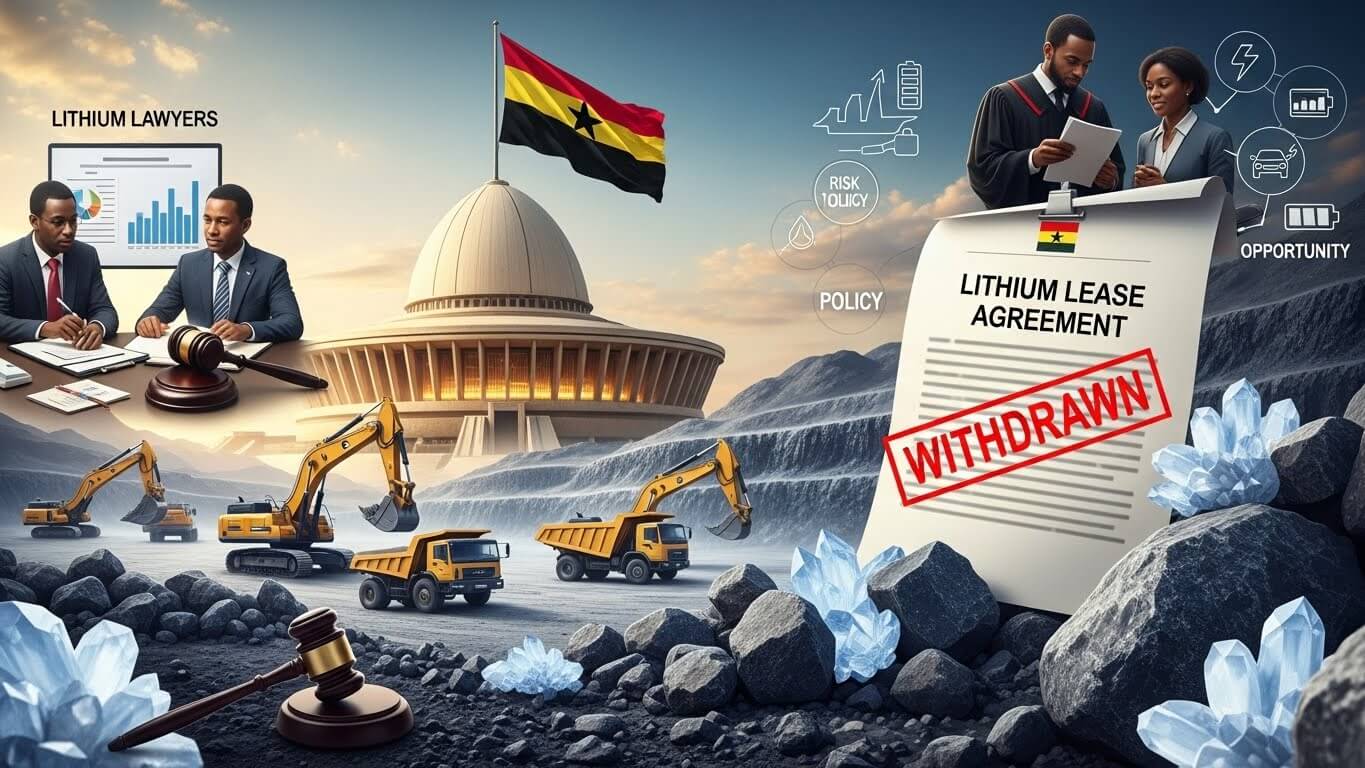
The instrument that became the centre of Ghana’s lithium controversy was the proposed Mining Lease Agreement between the Government of Ghana and Atlantic Lithium (Ghana) Ltd for the Ewoyaa Lithium Project, laid before Parliament in 2023–2024 pursuant to Article 268(1) of Ghana’s 1992 Constitution.
Article 268(1) requires parliamentary ratification for transactions granting rights or concessions for exploitation of minerals and natural resources. The Ewoyaa mining lease required ratification but did not obtain it.
The most important point: the lease was withdrawn by the Executive; it was not rejected by Parliament. That distinction matters. Withdrawal preserved discretion and avoided the constitutional embarrassment of a failed ratification vote, while signaling that the confidence threshold had not been met.
2) Why the Lease Was Removed
The withdrawal followed sustained objections from civil society, policy analysts, and the Parliamentary Minority. The core concern was not purely legal validity—rather it was value capture, timing, and national leverage.
Lithium is a volatile, high-stakes commodity. The concern was that Ghana was being asked to lock in long-term terms before:
-
the global lithium price curve stabilized,
-
investor bargaining power shifted permanently, and
-
a national consensus formed around strategic minerals.
From the Executive’s perspective, withdrawal became a safer constitutional reset: a way to re-engage with the fiscal terms and rebuild legitimacy.
3) What Is Before Parliament Now (Precisely)
Contrary to popular belief, Parliament is not currently debating a lithium mining lease. What is before Parliament (or imminent in parliamentary workflow) is a general royalty framework: the Minerals and Mining (Royalty) Regulations, 2025, a Legislative Instrument made under Section 25 of the Minerals and Mining Act, 2006 (Act 703).
This shift changes the battleground:
-
From project-specific ratification politics under Article 268, where Parliament votes on one concession;
-
To subsidiary legislation that sets general royalty bands across minerals, including lithium, subject to parliamentary scrutiny in a different manner.
4) What the New Framework Does—and Does Not Do
The royalty regulations do three primary things:
-
Introduce a sliding-scale royalty regime for minerals, including lithium (starting at a higher floor and increasing as price rises).
-
Establish a Community Development Fund for host communities.
-
Standardize elements of the fiscal regime across minerals to improve predictability.
But it is equally important to state what it does not do:
-
It does not approve a specific lithium project.
-
It does not grant a mining right.
-
It does not itself mandate local processing.
-
It does not settle governance terms for state equity participation.
In other words: it fixes the fiscal surface, not the full strategy.
5) The Constitutional Tension: Who Is Right?
This is not just a policy disagreement. It is a dispute about fiduciary duty.
Government’s argument:
A general royalty regime creates predictability, reduces case-by-case politicisation, and still preserves Parliament’s oversight through:
-
review of subsidiary legislation,
-
budget oversight, and
-
future ratification of project-specific leases.
Critics’ argument:
Minerals are held in trust for the people. Trust implies maximisation of long-term national benefit—not only revenue certainty and administrative efficiency. Parliament’s ratification role is substantive, not ceremonial. Strategic minerals demand heightened scrutiny, not streamlined processes that appear to reduce leverage.
Both readings can sound constitutionally plausible. That is what makes this moment politically and economically sensitive.
6) Why “Scandal” Talk Persists Even Without a Court Finding
There is no judicial finding of corruption in Ghana’s lithium process. But resource governance collapses not only through theft; it collapses through opacity and contradiction.
The controversy escalated because it stopped being purely about percentages and became about credibility. If Parliament was previously assured that all consultations and requirements were satisfied, then a later withdrawal citing insufficient consultation creates a contradiction Parliament is entitled to interrogate.
In extractives, perception is not cosmetic—it is consequential. When citizens cannot see the logic, they question not only the math but the motive. The risk is not merely scandal; it is a trust deficit that damages Ghana’s negotiating power and investor credibility simultaneously.
7) The Money Question: Why Margins Matter More Than Headlines
Lithium has seen dramatic price swings—peaks and drops. Volatility does not negate value; it increases the need for strong fiscal design.
Over the life of a major project like Ewoyaa:
-
gross resource value can run into billions,
-
small royalty differentials can translate into major national foregone value, and
-
early concessions can create opportunity costs that are hard to reverse without legal and reputational risk.
The fear is not today’s price. It is tomorrow’s boom—and whether Ghana’s framework captures upside when leverage is highest.
8) The Strategic Mineral Reality Ghana Cannot Ignore
Lithium is increasingly treated globally as:
-
an industrial policy tool,
-
a geopolitical asset, and
-
a national security input into future mobility and energy storage.
Ghana is being judged against evolving standards worldwide. In a world racing to secure supply chains, the country that negotiates wisely moves from extraction to influence.
9) The Bottom Line for Investors
The key investor takeaway is this: Ghana is not rejecting lithium. Ghana is renegotiating governance posture.
The state is testing a shift from project-level fiscal bargaining to a general framework. That can improve predictability, but it also raises a central investor question: what complementary conditions will Ghana insist on when the project lease returns—especially on value addition, state influence, and transparency?
Serious investors should not fear scrutiny. They should welcome a stable, legitimate framework. What markets punish is not regulation—it is unpredictability and mistrust.
Lithium will define the next industrial era. Ghana will not get a second first chance. History will not only ask whether the law was followed. It will ask whether the law was used wisely.
Contact Us
The Law Office of Clinton Consultancy
Accra, Ghana | Regional Presence Across Africa
Business WhatsApp: +233 27 252 2695
Email: amanda@clintonconsultancy.com
If you are an investor, developer, offtaker, or policy stakeholder in Ghana’s lithium sector, we provide:
-
mining and fiscal framework advisory,
-
transaction structuring and risk allocation,
-
parliamentary and regulatory strategy support,
-
due diligence and compliance, and
-
dispute prevention and arbitration-ready contracting.